top of page

THE SMILE CLINIC

Dental health, explained simply

Everything you need to make confident decisions about your smile, dental guides, tips, and answers from The Smile Clinic, Whitefield.


Are you up in the night with a pounding tooth? Donโ€™t panic! Hereโ€™s what you need to know. In case of severe toothache what India searches for, first things to do are: taking a proper OTC painkiller if safe for you, using clove oil properly if available, applying a cold compress, rinsing with warm salt water and avoiding trigger factors. All of them can help relieve tooth pain but they do not substitute for dental care.

Your primary objective within the next 24 hours is reducing your symptoms safely and preventing further aggravation until you can go to a dentist.


The 5 Things to Do Right Now

Step 1: Take an Appropriate OTC Painkiller Immediately If you experience intense tooth pain, an appropriate over-the-counter painkiller can help to decrease pain until you receive dental care.

There are many people who search for a fast-acting method to deal with a toothache. Taking a proper painkiller may help to manage symptoms for a while, provided it is safe for your age, medical condition, allergy and current medications.

Follow all recommendations and never exceed the dosage stated on a package.

Painkillers for tooth pain

Remember, that painkillers decrease pain, but they donโ€™t heal the cause of your tooth pain. No matter how good you feel, the problem with your teeth is still there.

Some people want to know how to get rid of a toothache using paracetamol. Paracetamol can help to manage your pain temporarily, but it can only serve as a way to alleviate symptoms, but not to treat them. Step 2: Apply Clove Oil If Available

The most popular home remedy for years has been the application of clove oil.

And the reason why people still search for it is simple: clove oil may help to relieve symptoms temporarily.

Clove oil for tooth pain

How to Use It Properly Put a drop of oil on a cotton ball.

  • Put it gently near the site where you have pain.

  • Donโ€™t overuse it.

  • Never swallow it.

Many people are interested in the application of this oil since it can help to relieve pain temporarily, especially when you cannot receive dental care.

Still, clove oil isnโ€™t a cure. If there is an infection, decay or inflammation of the nerve, then you should still visit your dentist. Step 3: Apply a Cold Compress to the Cheek

Cold compress is one of the safest methods to help you to relieve severe toothache. What It May Help With It can help to relieve:

  • swelling

  • inflammation

  • discomfort

    Cold compress for tooth pain

    What It Wonโ€™t Be Able To Do


    It wonโ€™t be able to:

    • remove an infection

    • repair a cavity

    • eliminate the cause of pain


    Take an ice pack or a cold pack wrapped in a thin cloth and put it on the outer side of your cheek for short periods of time. This can be especially useful if you experience toothache swelling face symptoms.

    If you notice swelling in your face, donโ€™t think that itโ€™s enough to use home remedies only. Swelling can be a sign of developing an infection and you should urgently visit your dentist.


Step 4: Rinse with Warm Salt Water Warm salt water rinse is a cheap and effective remedy.

The Correct Way

  • Use warm water, not hot.

  • Dissolve some salt in the water.

  • Swish gently.

  • Spit the water out.

Donโ€™t wash too hard. Warm salt water may help to clean and soothe inflamed gums. It can be very useful as a toothache for the first 24 hours. Although it will help to relieve symptoms, it will not heal the cause of your pain.


Step 5: Stay Away from the Factors Aggravating Your Situation

This step is usually ignored. There are some activities which will make your tooth pain much worse.

Do Not Eat Hot or Cold Things

It is known that sensitive teeth react badly to the changes in temperature.

Do Not Bite on the Problematic Side

Some additional pressure might increase pain level.

Do Not Lie Flat

In some cases lying flat increases the pressure in the head and jaw, increasing pain level.

Do Not Feel Your Tooth All the Time

Constant touching irritates already irritated tissues. The patients looking for the toothache before seeing the dentist are mostly concentrated on what should be done. Just as important are the actions which must be avoided to prevent aggravation of the condition.


What You Should NOT Do: Popular Indian Home Remedies Which Will Only Make It Worse

What you should not do when dental pain

People tend to give lots of recommendations when somebody is in pain. However, some of them can actually cause new problems.

Do NOT Put Aspirin on the Tooth

This is still among the most popular myths. Aspirin should be swallowed when it is used properly โ€“ it should not be put on the tooth directly. Putting it on gums leads to chemical irritation and damages the tissues.

Do NOT Ignore the Facial Swelling

If you have toothache with facial swelling symptoms, do not simply wait several days for it to go away. Sometimes facial swelling indicates infection and requires immediate attention.

Do NOT Use Somebody Else's Antibiotics

The antibiotics should be used under the doctor's supervision. Taking left-over or somebody else's antibiotics can only make things worse and complicate the diagnosis process.

Do NOT Use Too Much Heat

Heat application can exacerbate the swelling caused by the infection.

Do NOT Rely Only on the Tooth Abscess Home Remedy

You might find many suggestions about how to deal with tooth abscess using home remedies on the Internet. Abscess is the pocket of infection, which contains bacteria and inflammatory stuff.

Though some things could relieve the pain for some time, the infection needs professional attention.


When Should This Be Considered a Dental Emergency?

Sometimes, toothache can wait until the next possible appointment. Other times, you need an urgent dental examination. Signs You Need Urgent Attention for Your Toothache

Swelling of the Face

Visibly swollen faces are one of the key signs to look out for.

Fever

A fever associated with your toothache might mean infection.

Difficulty Swallowing

This condition requires immediate examination.

Difficulty Opening Your Mouth

Trouble opening your mouth is a serious sign of inflammation.

Severe Pain That Doesn't Go Away

Severe toothache that hasn't been relieved by any temporary measures needs an examination.

Injury or Trauma

A dental trauma must be examined right away. If you search for emergency toothache relief India, it is essential to know these warning signs. Swelling must never be overlooked.


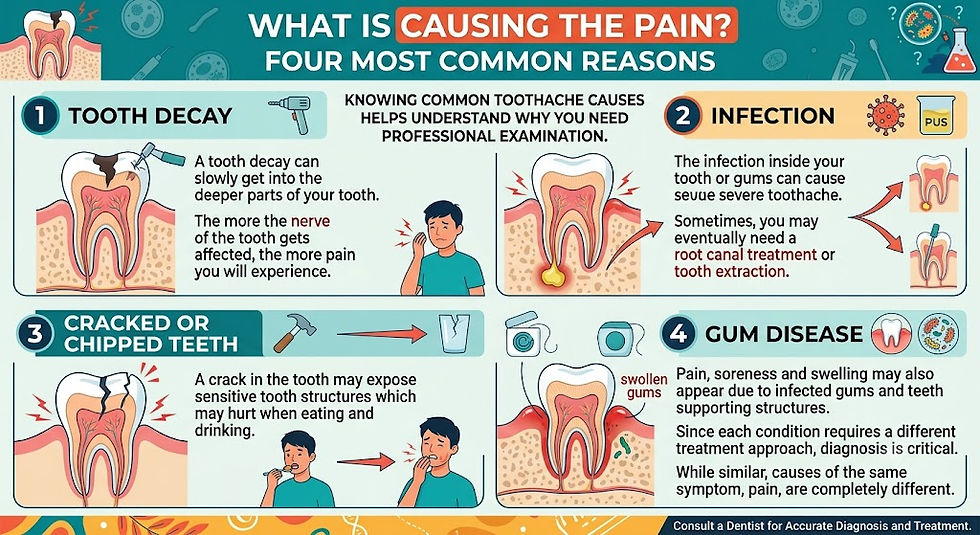
What Is Causing the Pain? Four Most Common Reasons

What is causing tooth pain

Knowing common toothache causes helps understand why you need professional examination.

  1. Tooth Decay

A tooth decay can slowly get into the deeper parts of your tooth. The more the nerve of the tooth gets affected, the more pain you will experience.

  1. Infection

The infection inside your tooth or gums can cause severe toothache. Sometimes, you may eventually need a root canal treatment or tooth extraction.

  1. Cracked or Chipped Teeth

A crack in the tooth may expose sensitive tooth structures which may hurt when eating and drinking.

  1. Gum Disease

Pain, soreness and swelling may also appear due to infected gums and teeth supporting structures. Since each condition requires a different treatment approach, diagnosis is critical. While similar, causes of the same symptom, pain, are completely different.


FAQย 

Q1: What is the fastest way to stop a toothache at home in India?

The fastest approach usually involves combining safe temporary measures: an appropriate over-the-counter pain reliever if medically suitable, a cold compress, and gentle salt water rinses. Clove oil may also provide short-term relief for some people. However, these methods only reduce symptoms temporarily. A dentist must identify and treat the underlying cause of the toothache.

Q2: Is clove oil safe for toothache?

Yes, clove oil can be used carefully as a temporary measure for toothache relief. It contains eugenol, which may provide mild numbing effects. Only a small amount should be used, and it should be applied gently. Excessive use may irritate tissues. Clove oil should be viewed as temporary symptom management rather than a replacement for professional treatment.

Q3: How long can I wait before seeing a dentist for a toothache?

The sooner, the better. If pain persists beyond a day or two, professional evaluation is strongly recommended. Waiting longer increases the risk that the underlying problem may worsen. If swelling, fever, difficulty swallowing, or severe pain is present, you should seek urgent dental care rather than waiting for symptoms to improve.

Q4: When is a toothache a dental emergency?

A toothache becomes a dental emergency when it is accompanied by facial swelling, fever, difficulty swallowing, difficulty opening the mouth, trauma, or severe pain that does not improve. These symptoms may indicate infection or another condition requiring prompt treatment. In such situations, delaying care is not advisable.


If you've recently been told you need a filling, you're probably wondering two things: How serious is this? and Which filling should I choose?


It's quite normal since a lot of patients are confused about such terminology like composite, GIC and ceramic fillings.

Apart from that, people usually wonder how much fillings cost, how long they last and whether there are any side effects.


The good thing is that dental fillings are one of the most effective treatments in modern dentistry. If the cavities are found early, filling could fix the tooth, stop the development of decay and save you from more complicated dental procedures in the future.

Here we are going to talk about major dental fillings types in India, the way they function, how their cost is calculated and what to expect when recovering.

Why Fillings Are Necessary - What Will Happen if Cavities Are Ignored

The filling is the method to repair your tooth decayed due to the decay. Bacteria present in your mouth combine with food residues and produce acids, damaging tooth enamel and forming a cavity.

In the beginning, you may feel no discomfort at all, and patients are often surprised when their dentist discovers a cavity during routine checkup.

But if the cavity is left untreated, it will become bigger.

Untreated decay will eventually:


  • Produce sensitivity

  • Painful when eating

  • Weaken tooth structure

  • Reach the nerve of your tooth

  • Create a necessity for root canal treatment


A simple dental cavity filling procedure is the most non-invasive solution to treat a decay at an early stage.

That's why it's important to visit your dentist regularly. It will be easier, cheaper and faster to fix a small cavity now than to treat a severely damaged tooth in the future.

3 Major Types of Dental Fillings Available in Bangalore


When talking about dental filling types in India, here are four most popular options:

  • Composite filling

  • Glass Ionomer Cement (GIC) filling

  • Ceramic inlays and onlays

Each type of filling has its pros, cons and cases when it performs better than others.

Choice of filling is individual and depends on such factors as:

  • Location of the tooth

  • Size of the cavity

  • Amount of bite pressure

  • Cosmetic needs

  • Budget


Let's see each of them separately.


Composite (Tooth-Coloured) Filling โ€“ Pros, Cons, Cost, Life Span

Composite fillings are currently one of the most widespread methods of modern restorative dentistry.

These fillings are done using tooth-coloured resin materials, blending well with your natural teeth.


Advantages of Composite Fillings

  • Natural look

  • Colours like a tooth

  • Bonds with the structure of the tooth

  • Suitable for front and back teeth

  • Conserves more tooth structure


Aesthetics is usually the main reason why people prefer composite fillings.


Disadvantages of Composite Fillings

  • Can wear faster in large restorations

  • Can be technique sensitive

  • Require careful placement


Life Span

People often ask - how long does a tooth filling last in India? Good quality composite fillings can last many years depending on:

  • Oral hygiene

  • Size of the cavity

  • Location of the tooth

  • Grinding habit

  • Dietary habits


Cost Factors

As composite fillings cost more than basic restoration materials because of materials themselves and additional time required for placement. At The Smile Clinic Whitefield, charges start from โ‚น1500

Glass Ionomer Cement (GIC) Filling โ€“ When Is It Used? Benefits, Drawbacks, Ideal Candidates

Another filling material which is popular in India is glass ionomer cement (GIC). When patients compare GIC filling vs composite India, they want to know how and when each material is used.


Advantages of GIC

  • Releases fluoride

  • Forms chemical bond with the tooth structure

  • Can be used in certain situations

  • Is commonly used in paediatric dentistry and non-load bearing areas


Drawbacks

  • Has lower durability than composite

  • Does not perform well in large chewing areas

  • Has low wear resistance


Ideal Candidates for GIC Fillings

GIC may be recommended for:

  • Small cavities

  • Restoration of root surface areas

  • Temporary fillings

  • Certain pediatric procedures

The choice always depends on the particular clinical case rather than any hard-and-fast rules.

Ceramic Inlay/Onlay โ€“ The Best Material, When It's Appropriate

Ceramic restorations are somewhere in-between fillings and crowns. These are the custom-made restorations for larger defects of the tooth.

What is a Ceramic Inlay?

Inlay is placed inside the defect.


What Is an Onlay?

Onlay covers a larger area of the tooth.


Advantages

  • Excellent aesthetics

  • Durable

  • Stain-resistant

  • Custom-made for perfect fit


Drawbacks

  • More expensive

  • Multistep procedure

  • Not needed for every cavity


For larger restorations, where a filling cannot provide sufficient strength, ceramic restorations may become a good long-term solution.


Cost of Each Type in Bangalore โ€“ What to Expect

Dental filling cost Bangalore is one of the most common questions. Patients justifiably want to be informed about how the cost differs.


Factors that Influence Cost

There are several factors that influence the final cost of tooth filling in Bangalore: Type of Filling Material

Each of the filling materials (composite, amalgam, GIC, ceramic) requires a special approach, materials, laboratory work.

Cavity Size

Usually, larger restoration requires more time and materials.

Location of Tooth

Front and back teeth might have their specific features.

Complexity of the Restoration

The cavity can be easy or rather complicated.

Understanding Tooth Filling Types Cost

It should be noted that while looking for tooth filling types cost information one should understand that the cheapest option is not necessarily the best one.

The optimal filling provides a combination of such components:

  • Durability

  • Aesthetic qualities

  • Functionality

  • Budget

  • Clinical appropriateness

Since every cavity is unique it needs to be assessed individually to give an appropriate quotation.


Tooth Filling Procedure Steps โ€“ What to Expect During Treatment

Tooth filling - step by step

Many patients become worried simply due to their lack of knowledge regarding the procedure.

The good news is that the filling procedure is quite simple and quick.

Step 1: Examination

A dentist evaluates the cavity and chooses a proper restorative material.

Step 2: Preparation

The decayed part of the tooth is carefully removed.

Step 3: Cleaning

The area is carefully cleaned and prepared for the procedure.

Step 4: Placement of Filling Material

Filling material is applied and properly shaped.

Step 5: Bite Adjustment

A dentist checks your teeth contact point.

Step 6: Finishing

Final polishing of the restoration. These tooth filling procedure steps can be completed within one visit.

The Hidden Truth About Fillings: Sensitivity, Bite Discomfort, Why It Happens And How Long It Lasts


Most patients do not expect to have any mild symptoms after their procedures. In reality, some minor side effects are possible and usually expected. Tooth Filling Sensitivity After Procedures

Among the most commonly experienced concerns is tooth filling sensitivity.

You might experience:

  • Sensitivity to cold foods

  • Sensitivity to sweet foods

  • Discomfort while chewing

This happens as a result of adaptation of the tooth after the treatment. For many patients, sensitivity disappears within several days or even weeks.

Bite Is Not Even

Another possible concern is uneven bite. Even small changes in the filling's height will make you feel discomfort. However, this problem can be easily solved during the follow-up visit.

Temporary Gum Irritation

The tissues surrounding the filling might become irritated. This is a temporary symptom.

What Is the Reason To Contact Your Dentist?

Do contact your dentist in case:

  • The pain is severe

  • The symptoms are getting worse instead of improving

  • You cannot chew normally

  • The sensitivity lasts for a prolonged period of time

Knowing about these side effects makes people feel less worried.

How to Ensure That Your Filling Will Last For Years?

No matter what kind of filling material has been used, there are several recommendations to prolong its life span.

Maintain Proper Oral Hygiene

Brush twice a day and floss.

Decrease the Frequency of Eating Sugary Foods

This will prevent decay from developing around your restoration.

Visit the Dentist Regularly

It will allow detecting the problems at their early stages and avoid bigger procedures later.

Use the Night Guard If Needed

Bruxism significantly reduces the life span of restorations.

Deal With the Problem Promptly

If your filling is loose, chipped or causes discomfort, contact your dentist as soon as possible.

FAQ


How much does a dental filling cost in Bangalore?

Dental filling costs vary based on the material used, the size of the cavity, the complexity of the restoration, and the tooth being treated. Composite fillings, amalgam restorations, GIC fillings, and ceramic options all involve different treatment requirements. A clinical examination is necessary before an accurate treatment estimate can be provided. For charges it usually starts from 1500 onwards.


How long does a tooth filling last?

The lifespan of a filling depends on the material used, oral hygiene habits, cavity size, chewing forces, and overall dental health. Many fillings last for several years when properly maintained. Regular check-ups help identify wear, leakage, or damage before they become larger problems. Good daily oral care plays a major role in longevity.


Why is my tooth sensitive after a filling?

Temporary sensitivity after a filling is common, particularly with deeper cavities. The tooth may react to cold foods, sweet foods, or pressure for a short period while it adjusts. In most cases, symptoms gradually improve. If sensitivity becomes severe, worsens over time, or affects normal chewing, your dentist should evaluate the tooth.


Cavity or sensitivity? Get a proper assessment at The Smile Clinic, Whitefield โ€” โ‚น400 consultation. Call or WhatsApp 7019807631.


Introduction


Bad breath, also known as halitosis, affects millions of people and can impact confidence, relationships, and daily interactions. While occasional bad breath is normal, persistent bad breath may be a sign of an underlying dental issue.


1. Poor Oral Hygiene

Plaque and food particles can build up between teeth and along the gum line, leading to unpleasant odors.


2. Gum Disease

Persistent bad breath is often one of the earliest signs of gum disease.

Symptoms:

  • Bleeding gums

  • Swollen gums

  • Bad taste in mouth


3. Tooth Decay and Cavities

Bacteria trapped inside decayed teeth can create a strong odor.


4. Dry Mouth

Saliva helps clean your mouth naturally. Reduced saliva production allows bacteria to multiply.


5. Tongue Bacteria

The tongue can harbor millions of bacteria that contribute to bad breath.


6. Smoking and Tobacco Use

Tobacco products not only cause odor but also increase the risk of gum disease.


7. Underlying Health Conditions

Sometimes bad breath can be linked to sinus infections, digestive issues, or medical conditions.


How to get rid of bad breath?

When Should You See a Dentist?

If your bad breath persists despite good oral hygiene, it may be time for a professional dental evaluation.


Concerned about persistent bad breath?


Book a dental consultation at The Smile Clinic Whitefield and identify the root cause of the problem.

Ready to book your appointment?

Call or WhatsApp us, same-day appointments available at both Whitefield clinics.

First consultation just โ‚น400.

The Smile Clinic

Your smile. Our promise.

Whitefield's specialist-led multispeciality dental & implantology centre.

Two clinics, one standard of care.

Borewell Road

Seegehalli

๐Ÿ“ž 70198 07631

๐Ÿ’ฌ WhatsApp

๐Ÿ’ฌ WhatsApp

Clinic

Meet Dr. Benjamin

Testimonials

FAQ

Blog

  • Instagram
  • Facebook
  • LinkedIn

© 2026 The Smile Clinic · thesmileclinic.co.in

Mon–Sun 9:30 AM–1 PM & 4–8 PM · Tuesday closed

bottom of page